The American Boychoir
Early
History of the American Boychoir
Part
I: Huffman Era Began with Dream of “America’s Singing Boys”
By
Lori Chambers
|
Editor’s
Note: This is the first in a series of articles on the early history of The
American Boychoir. The next installment will highlight the launch of the first
national tours, the founding of the summer camp at Chatauqua, the
establishment of the boarding school, and the move to Princeton. |
||||||||||||||||||||||||
|
Early
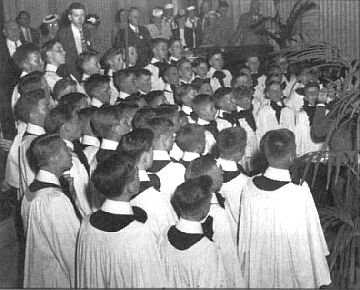
one Saturday morning in Columbus, Ohio, 10-year-old Hank Speaks, ABS ’41,
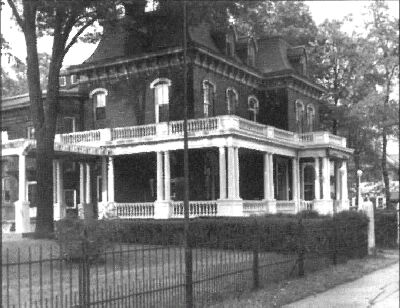
entered the La High House on the grounds of the Broad Street Presbyterian
Church. As instructed, he located the stairs that led to the second-floor
office of the church’s music director, Herbert Huffman, and saw 11 boys, one
to a step, in line in front of him. Hank took the next place. It was 1937, and
he was the 12th boy in line for the first-ever audition of an
after-school choral group that would one day become America’s premier
boychoir.
“Mr.
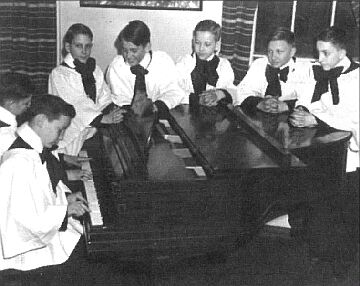
Huffman had me sing any song I wanted and run through a scale, while his wife,
Mary, played the piano,” remembers Speaks. When Hank was done, Mr. Huffman
seemed very impressed and asked the aspiring chorister whether he had had
professional training. “That made me feel so proud,” says Speaks, “although
I realize now that he probably said that to all the boys!”
Such
encouragement was typical of the founder of the Columbus Boychoir, a man
Speaks calls “wonderful, sincere, talented, a second father to me.” A
young man at the time, 32 years old, Herbert Huffman was an Ohio native and a
recent graduate of Westminster Choir College. As a student in 1929, he had
toured Europe’s great musical centers and first conceived the dream of
founding a boychoir. As a member of the Kiwanis Club of Columbus, he received
that opportunity when James Ralph Riley, director of the club’s Boys and
Girls Committee, enthusiastically supported Kiwanis’ sponsorship of a choir
for disadvantaged boys.
For
several months, the new choir practiced each Wednesday after school and each
Saturday morning, with Huffman laboring to fashion a highly trained
professional boychoir from a leisure-time singing group. The boys came from
different schools in different neighborhoods, and walked or rode the bus to
rehearsals. Speaks remembers hiking 14 blocks each way, a trek he didn’t
mind because “I got to sing good music.” The choir sang several times at
church services before making their public debut at Veterans Memorial Hall on
Broad Street. Once a month, the boys sang at the Kiwanis meeting hall and were
rewarded with a turkey dinner with all the trimmings.
For
city-bred boys whose families were struggling through the Depression, the
choir was more than a chance to sing: it was a revelation that “there were
other things in life than drudgery and hard work,” says Speaks, whose father
supported eight children on $25 a week. A turkey dinner – when it wasn’t
Easter or Christmas! – was a sign to these boys that there was a better life
to be had. The choristers put hearts and souls into their music, and soon
Huffman’s choir was invited to appear in Marion, Dayton, and Cincinnati. “Mr.
Huffman told us that one day we would travel all over the world,” says
Speaks, who, at 73, still sings in choirs. “We didn’t believe him – but
all his dreams came true.”
Launch
of the Boychoir School
Within
two short years, Huffman knew that the choir’s full potential could only be
realized through a cohesive regimen of daily musical and academic education: a
school for musical boys. In 1939, Huffman managed to scrape together $6,000 to
begin on a modest scale in a church-owned building at 788 East Broad. The next
year, Harry C. Marshall, a recently retired high school principal, signed on
as headmaster. A man with “snowy hair and twinkling eyes,” according to
one contemporary newspaper, Marshall was nonetheless and old-style
disciplinarian who taught the boys to march in military formation. “Harry
Marshall instilled the characteristic quality of the school – the desire for
excellence,” declares Don Christianson, ABS ’48.
Marshall
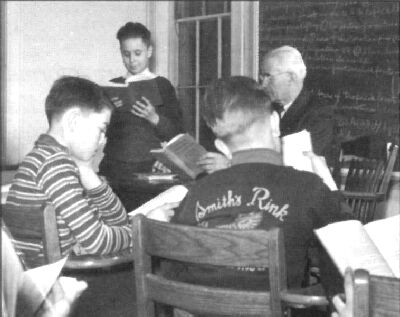
developed a curriculum, recruited teachers, and received formal approval for
the school from the Columbus Board of Education. Boys attended the 5th
through 8th grades before going on to the public high school in
their own neighborhood. Music was taught once in the morning and once in the
afternoon, remembers Bill Saltz, ABS ’44, who says that all the teachers “were
super. Each class had only 10 boys, so we got a lot of individual attention.
Let me tell you, high school was a breeze after the education I’d had.”
For
Saltz, the school “was the best of both worlds.” The streetcar took him
from home to school, “where there was a nice mix of boys from all over the
city. We were all great friends and played baseball on the diamond and games
in the gym at the church. And, after school, we went home and still had our
old friends in the neighborhood.” The school remained true to the choir’s
founding ideals, charging no tuition and accepting any qualified boy
regardless of financial need, social background, or religious belief.
And
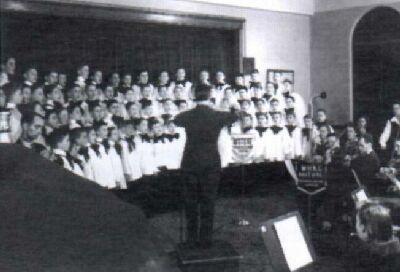
the boys sang, much to the delight of Columbus audiences. Walking from school
to performances at hotels, museums, and meeting halls in their choir robes and
flowing ascots, “we got quite a reception!” says Saltz. The choir received
further exposure by making frequent appearances on local radio stations; soon,
these broadcasts were picked up for national audiences by CBS. The choir’s
popularity was due in part to its eclectic repertoire. “Herb Huffman taught
them a wide spectrum,” says Don Bryant, who would join the boychoir in 1948
as associate musical director. “They did marvelous double choruses, show
tunes, pieces from the Renaissance, one-act operas. There was nothing like it
in America.”
Introduction
to the Nation
Siegfried
Hearst, a representative of the National Concerts and Artists Corporation,
attended a choir rehearsal in 1943 and immediately realized he’d found a
national treasure. World War II was raging: America was fighting for home,
hearth, and democracy – ideals embodied by these fresh-faced, angel-voiced
youngsters. As the February 1, 1943, Dayton Herald put it: “How
remarkable that the choir school…, a school supported by donated funds,
should be functioning during this war. The very fact points to America’s
idealism.” Hearst insisted that the choir must make an immediate appearance
in New York.
Huffman,
too, recognized the opportunity afforded by the tenor of the times. Because of
the war, the Vienna Choir Boys could not travel; by this time, the Columbus
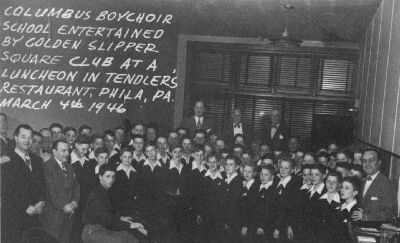
Boychoir had the polish and professionalism to step into the breach. Banishing
worries about how the trip would be paid for, Huffman loaded his 46 choristers
onto a train for their May 24, 1943, concert debut at New York’s Town Hall.
Headmaster Marshall also accompanied the group, commenting to a New York
newspaper that the boys “have behaved beautifully, [although] most have
never been away from Columbus before.” The boys were “properly impressed
by the tall buildings and imposing skyline,” the paper reported, and all
agreed that “New York’s some different from Columbus.”
New
Yorkers were just as enthusiastic about the “wide-eyed Buckeyes.” Their
Town Hall performance received warm praise from a New York Times critic
who called it “a rare feast,” noting that “better part singing, finer
dynamic shadings, clearer phrasing, or nicer feeling will seldom be found
anywhere.” While in New York, the choir also appeared on the CBS network
radio program “Hobby Lobby,” hosted by Dave Elman. In addition, at the
request of the Office of Inter-American Affairs, the choir recorded a set of
transcriptions to be broadcast in Latin America as a demonstration of the
educational opportunities available to young Americans.
Their
success in Manhattan opened the national stage to the Columbus boys. The CBS
national radio network featured the choir more than a dozen times, including a
yuletide concert in which they sang “a new favorite, Irving Berlin’s ‘White
Christmas,’” reported The Columbus Citizen. Accompanied by a
14-piece orchestra, the boys performed a series of Sunday evening broadcasts
on the Mutual network. The choir appeared with noted radio and stage artists,
including the Philadelphia Opera Association at the Civic Music Series in
Dayton. They were invited to the Republican National Convention in Chicago to
perform a song that a teacher had written for vice presidential candidate John
Bricker. Remembers Saltz: “Now that was wild!”
As
“their fame spread with their voices over the air,” in the words of early
historian Stephen I. Munger, Americans opened more than their hearts to the
choir. Contributions to support the school’s work came in from across the
country, and by 1946 Huffman was able to pay two-thirds of his teachers’
back wages and draw his own salary. With the financial strains of the charity
school eased, the musical visionary set his sights on the next phase of the
dream: to establish his choir as a cultural institution, musical ambassadors
who would represent the nation and become celebrated as “America’s Singing
Boys.”
All
photos courtesy of The American Boychoir archives. (Reprinted from the Spring 2001 issue of "Notes...") Copyright © 2001 The American Boychoir School |
Copyright © 2002 boychoirs.org
This page was last modified on
05 November 2004